How do I read this?
Traditional
The displayed wheel is your shared Western chart. The Traditional reading uses seven classical planets and whole-sign houses, so its house references can differ from this wheel’s displayed house system.
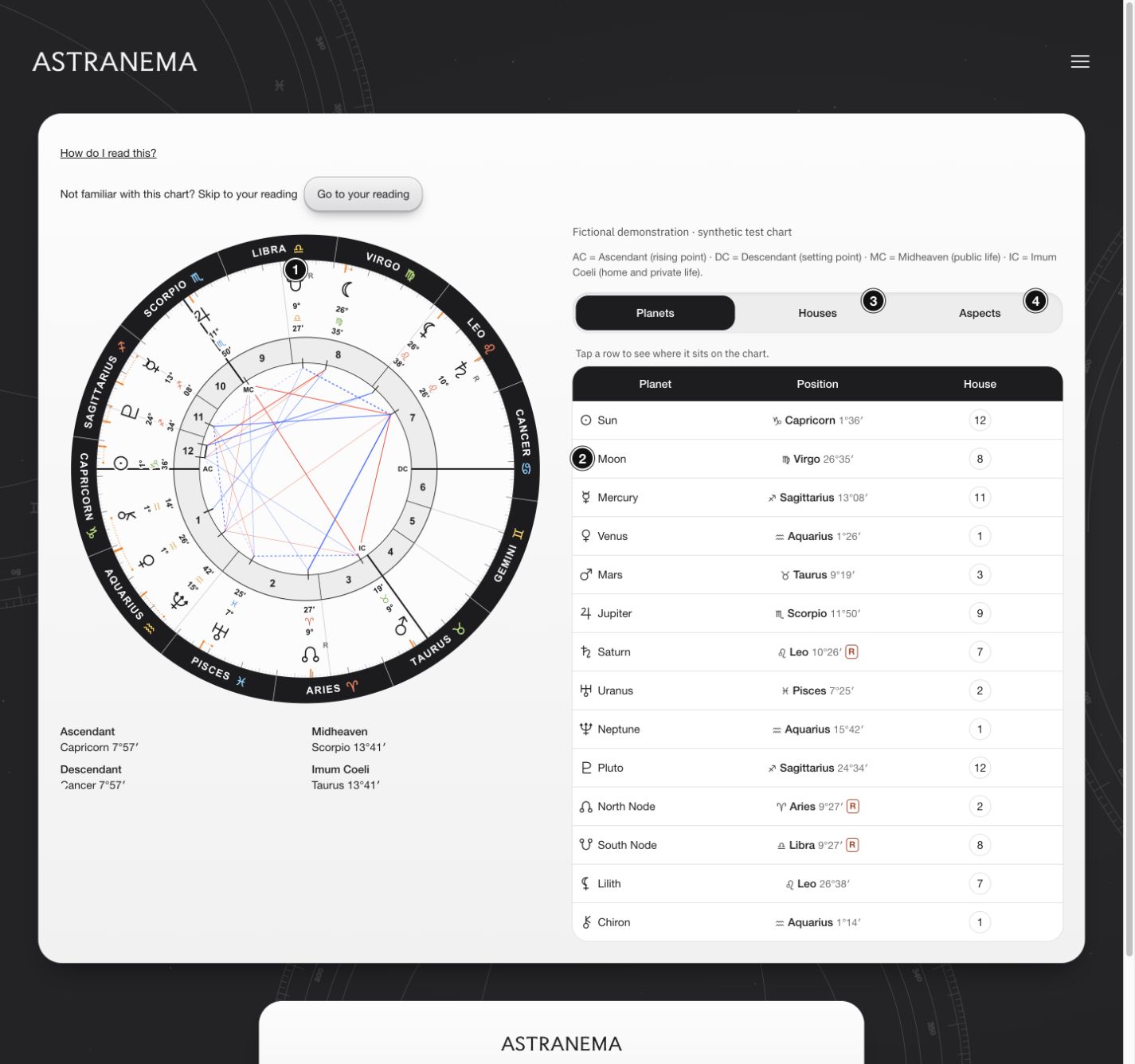
1. Start with the names around the edge
The outer ring contains the twelve zodiac signs. Each has a written name and a small symbol. In this demo, find Virgo on the ring near marker 1. A planet’s place in that ring gives its sign; you can look it up in the Planets table without memorising any symbols.
2. Find a planet in the table
At marker 2, read the Moon row: Virgo, 26°35′, house 8. Tap that row on your own chart to highlight its position. Moon is used as a symbol for emotional habits. Read across: the sign describes a style, the degrees locate it precisely, and the house number points to an area of life. These are symbolic interpretations, not measurements of personality.
3. Look at the numbered slices
The twelve houses divide the wheel into areas such as home, relationships and work. The Ascendant marks the rising point; the Midheaven is a reference for visibility and public life. Open Houses at marker 3 to read the full names. AC means Ascendant, DC means Descendant, MC means Midheaven and IC means Imum Coeli; the visible key also explains their everyday themes.
4. Treat the lines as connections
Open Aspects at marker 4. Read a row as first body → named connection → second body; the final number is the orb, or distance from an exact match. Trines and sextiles suggest ease; squares and oppositions suggest tension; conjunctions combine themes. A smaller orb means a closer geometric match, not a stronger prediction. Your reading brings these pieces together.
You can return to your chart with your browser’s Back button. The reading is there to put the symbols into everyday words.
Explore your chart
Get to know the placements, signs and stories behind a birth chart.