How do I read this?
Chinese system
Four columns, eight characters, and a table that translates them.
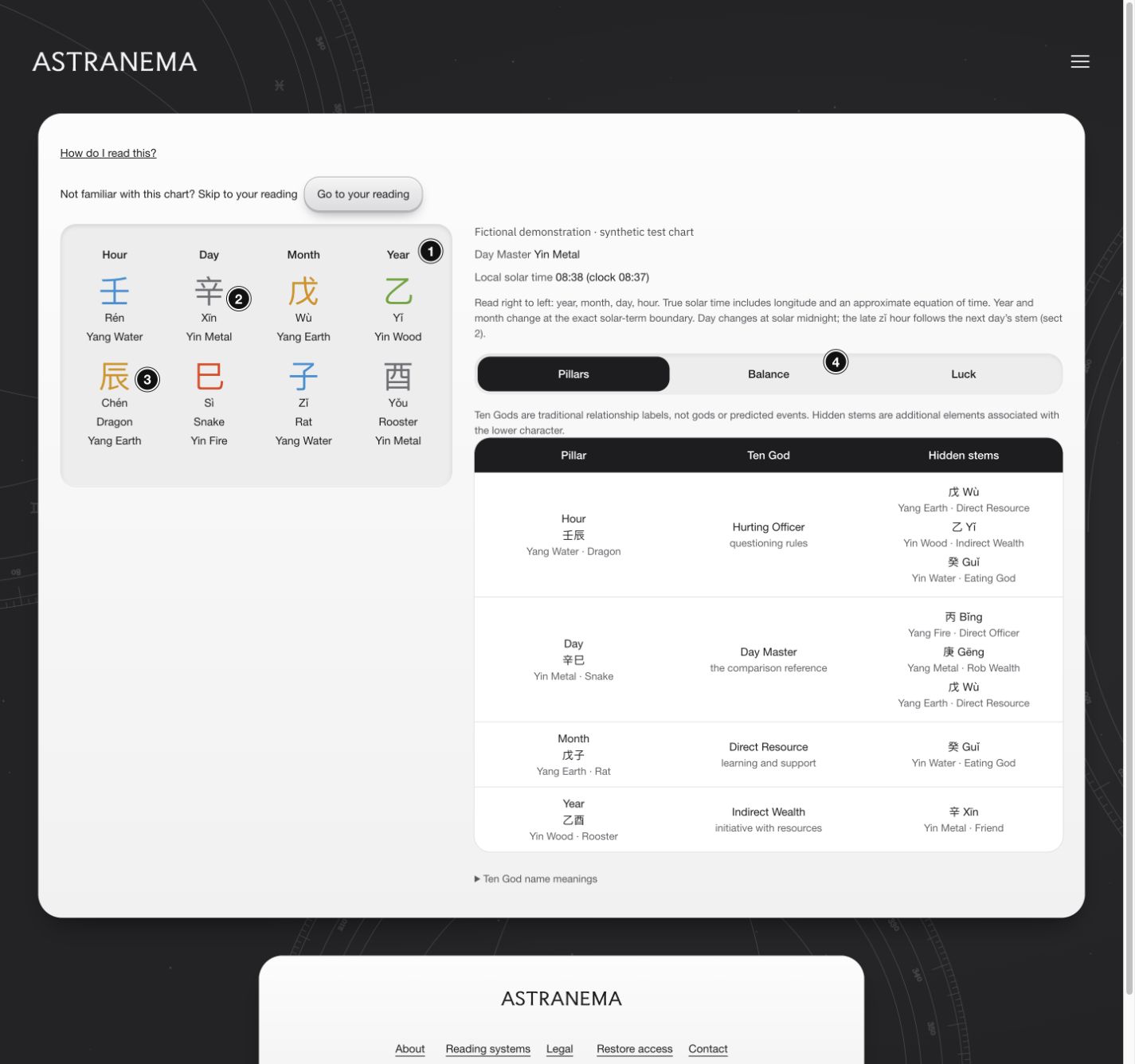
1. Begin at the right: year, month, day, hour
Start at Year beside marker 1, then move left to Month, Day and Hour. Each column is a pillar: two characters derived from part of the birth date or time. This display follows the traditional right-to-left arrangement: Year on the right, then Month, Day and Hour. It moves from the broad year toward the specific hour; the direction is a layout convention.
2. Find the top of the Day column
At marker 2, the demo’s Day column has 辛, pronounced Xīn, with Yin Metal written beneath it. That top character is called the Day Master. It is the reference point used to compare the other characters. The English element words beneath the characters let you follow along without reading Chinese.
3. Read each pair from top to bottom
At marker 3, read the Hour column: 壬 is Rén, Yang Water; below it 辰 is Chén, Dragon. The upper character is a stem; the lower one is a branch. Both carry an element association. The Pillars table lists the relationships to the Day Master under Ten God, and the additional elements inside each branch under Hidden stems. These are traditional labels, not literal gods or forecasts. Open “Ten God name meanings” below the table whenever a label is unfamiliar.
4. Use Balance as a starting point
Open Balance at marker 4 to see counts of the eight visible characters by element. Then try Luck: every cycle shows its characters, pronunciation, English meanings and dates. A larger count is not automatically better, and this is not a personality score. Luck shows the tradition’s named cycles, not guaranteed luck or events. The reading translates the combined pattern into habits and reactions.
You can return to your chart with your browser’s Back button. The reading is there to put the symbols into everyday words.
Explore your chart
Get to know the placements, signs and stories behind a birth chart.