How do I read this?
System Alignment
Compare the everyday themes suggested by your systems, without having to translate chart vocabulary.
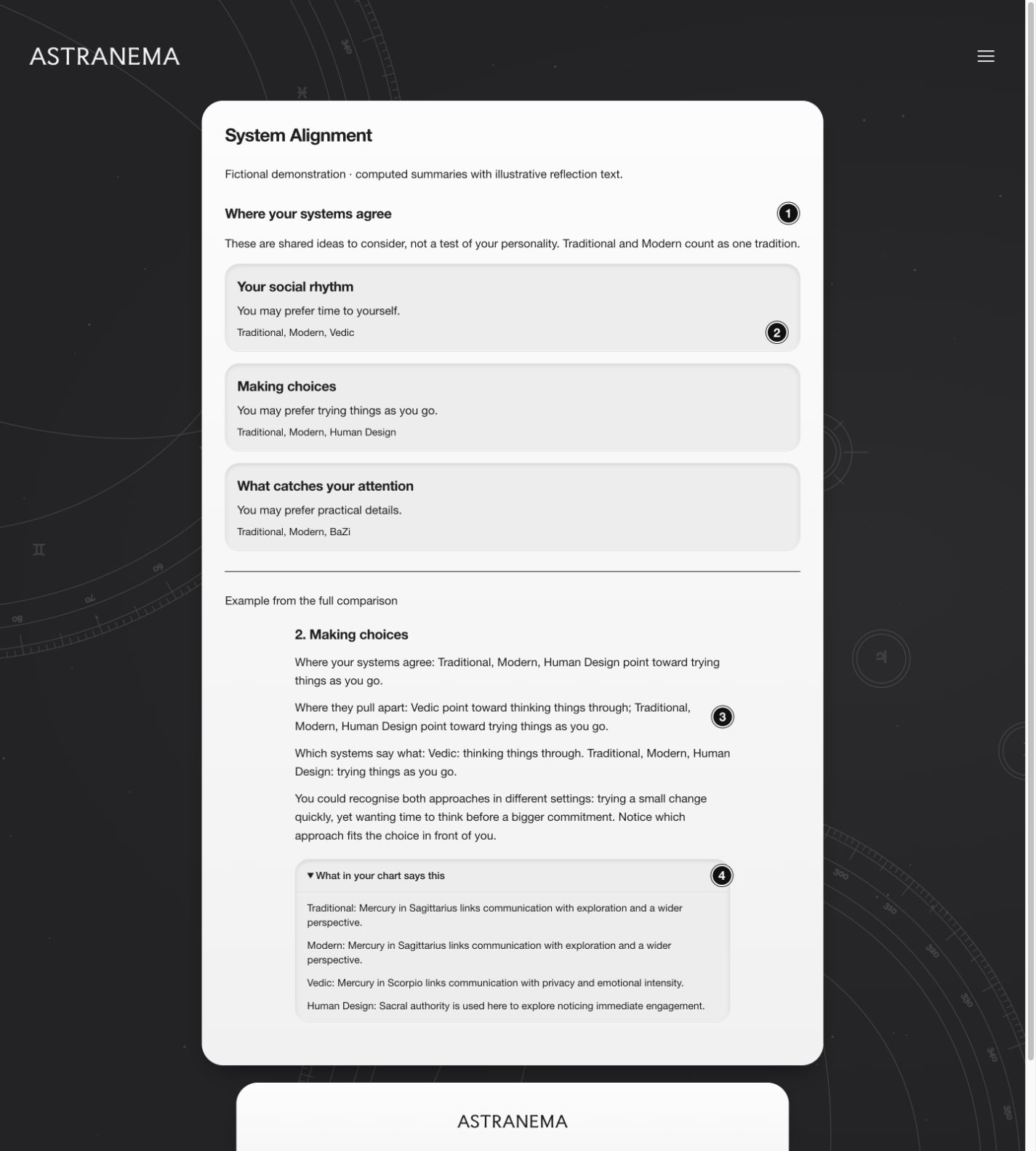
1. Start with a shared theme
At marker 1, the demo offers a few everyday preferences. These guest summaries use fixed rules applied to the calculated facts; they are not generated prose. If no theme is shared across different traditions, the page says so instead of inventing agreement.
2. Read the system names
At marker 2, the names tell you where a theme comes from. Traditional and Modern count together as one tradition, so their matching calculations alone cannot create an agreement. An absent system is not a vote against a theme.
3. Compare both sides in the full reading
At marker 3, read “Where your systems agree” and “Where they pull apart” within a theme. A difference is a contrast between interpretations, not a diagnosis or a prediction. If the supported comparison finds no difference, it says “No system disagrees here.” Notice which description fits a real situation for you.
4. Open the evidence only if you want it
At marker 4, “What in your chart says this” opens the named placements behind that theme, grouped by system. The screenshot shows this expanded; it starts closed on your reading. You can understand the main text without learning those labels.
You can return to your chart with your browser’s Back button. The reading is there to put the symbols into everyday words.
Explore your chart
Get to know the placements, signs and stories behind a birth chart.